• Skip to primary navigation
  • Skip to main content
  • Skip to primary sidebar

Pro Programming

Professional way of Programming: Learn C, C++, Java, Python, Dot Net, Android the professional way

  • Home
  • C MCQs
  • C/C++ Programs
  • Java Programs
  • C#
  • Python
  • MySQL
  • Topics
    • Arrays
    • Strings
    • Link Lists
    • Trees
    • Shapes
  • Projects
  • Articles
  • Games
You are here: Home / Archives for Python list sort()

Python list sort()

Python | Bigram formation from given list

Leave a Comment


When we are dealing with text classification, sometimes we need to do certain kind of natural language processing and hence sometimes require to form bigrams of words for processing. In case of absence of appropriate library, its difficult and having to do the same is always quite useful. Let’s discuss certain ways in which this can be achieved.

Method #1 : Using list comprehension + enumerate() + split()
The combination of above three functions can be used to achieve this particular task. The enumerate function performs the possible iteration, split function is used to make pairs and list comprehension is used to combine the logic.

test_list = ['geeksforgeeks is best', 'I love it']

print ("The original list is : " + str(test_list))

res = [(x, i.split()[j + 1]) for i in test_list

for j, x in enumerate(i.split()) if j < len(i.split()) - 1]

print ("The formed bigrams are : " + str(res))

Output :

The original list is : [‘geeksforgeeks is best’, ‘I love it’]
The formed bigrams are : [(‘geeksforgeeks’, ‘is’), (‘is’, ‘best’), (‘I’, ‘love’), (‘love’, ‘it’)]


Method #2 : Using zip() + split() + list comprehension
The task that enumerate performed in the above method can also be performed by the zip function by using the iterator and hence in a faster way. Let’s discuss certain ways in which this can be done.

test_list = ['geeksforgeeks is best', 'I love it']

print ("The original list is : " + str(test_list))

res = [i for j in test_list

for i in zip(j.split(" ")[:-1], j.split(" ")[1:])]

print ("The formed bigrams are : " + str(res))

Output :

The original list is : [‘geeksforgeeks is best’, ‘I love it’]
The formed bigrams are : [(‘geeksforgeeks’, ‘is’), (‘is’, ‘best’), (‘I’, ‘love’), (‘love’, ‘it’)]


If you like GeeksforGeeks and would like to contribute, you can also write an article using contribute.geeksforgeeks.org or mail your article to [email protected] See your article appearing on the GeeksforGeeks main page and help other Geeks.

Please Improve this article if you find anything incorrect by clicking on the “Improve Article” button below.

Article Tags :


thumb_up
Be the First to upvote.

Please write to us at [email protected] to report any issue with the above content.


Post navigation


Previous

first_page Python | Unique values in Matrix


Source link

Filed Under: c programming Tagged With: •   Dynamic Programming, About Us, Advanced Data Structure, Advanced Topics, Algo ▼, Algorithm Paradigms ►, Algorithms, All Algorithms, All Data Structures, Amazon product price tracker using Python, Analysis of Algorithms, Aptitude, Array, Backtracking, Best Python libraries for Machine Learning, Binary Search (bisect) in Python, Binary Search Tree, Binary Tree, Bit Algorithms, Branch & Bound, C, Campus Ambassador Program, Careers, Check for balanced parentheses in Python, Company Prep, Company-wise, Competitive Programming, Compiler Design, Computer Graphics, Computer Networks, Computer Organization, Computer Organization & Architecture, Constructors in Python, Contact Us, Contests, contribute.geeksforgeeks.org, contributed articles, Core Subjects ►, Courses, CS Subjects, CS Subjects ▼, CS Subjectwise ►, CSS, Data Structures, DBMS, Dealing with Rows and Columns in Pandas DataFrame, Decorators in Python, Decorators with parameters in Python, Design Patterns, Difference between C and Python, Digital Electronics, Divide and Conquer, Dividing a Large file into Separate Modules in C/C++, DS ▼, Engg. Mathematics, Experienced Interviews, Face Detection using Python and OpenCV with webcam, Find K Closest Points to the Origin, Functions in Python, Game Theory, GATE ▼, GATE 2019, GATE CS Corner, GATE Notes, GATE Official Papers, GBlog, Geek of the Month, Geek on the Top, Generating subarrays using recursion, Geometric Algorithms, Gradient Descent in Linear Regression, Graph, Graph Algorithms, Greedy Algorithms, Hashing, Heap, How to assign values to variables in Python and other languages, HTML, HTML & XML, ide.geeksforgeeks.org, Indentation and Comment in Python, Internship, Internship Interviews, Internships, Interview ▼, Interview Experiences, ISRO CS Exam, Iterative Letter Combinations of a Phone Number, Java, Java and Python, JavaScript, jQuery, Languages, Languages ►, Languages ▼, Last Minute Notes, Linear Regression Using Tensorflow, LinkedList, Machine Learning, Mathematical Algorithms, Matrix, Memoization using decorators in Python, Microprocessor, ML | Cancer cell classification using Scikit-learn, ML | Linear Regression, ML | Unsupervised Face Clustering Pipeline, Multiple Choice Quizzes, Namespaces and Scope in Python, Natural-language-processing, Operating Systems, Operator Overloading in Python, Output of Python Programs | (Dictionary), Pattern Searching, PHP, Placement Course, Polymorphism in Python, Practice, Practice Company Questions, Privacy Policy, Program Output, Project, Puzzles, Python, Python | Catching the ball game, Python | Convert a nested list into a flat list, Python | Convert a string representation of list into list, Python | Convert list of string into sorted list of integer, Python | Convert list of string to list of list, Python | Convert list of tuples into list, Python | Count occurrences of a character in string, Python | Find maximum length sub-list in a nested list, Python | Generate QR Code using pyqrcode module, Python | Image Classification using keras, Python | Implementation of Movie Recommender System, Python | Implementation of Polynomial Regression, Python | Insert list in another list, Python | Maximum sum of elements of list in a list of lists, Python | NLP analysis of Restaurant reviews, Python | Output Formatting, Python | Output using print() function, Python | Pandas Split strings into two List/Columns using str.split(), Python | Program to generate one-time password (OTP), Python | range() method, Python | Remove all values from a list present in other list, Python | Sort list according to other list order, Python | Sort list of list by specified index, Python | Sort the values of first list using second list, Python | Unique values in Matrix, Python | Ways to check if element exists in list, Python | Ways to sum list of lists and return sum list, Python for Data Science, Python in Competitive Programming, Python List Comprehension | Segregate 0's and 1's in an array list, Python list sort(), Python list-programs, Python program to add two numbers, Python program to check whether a number is Prime or not, Python program to create a list of tuples from given list having number and its cube in each tuple, Python program to find day of the week for a given date, Python program to print all Prime numbers in an Interval, Python program to swap two elements in a list, Python Programs, Queue, Quizzes ▼, Randomized Algorithms, School Programming, Searching Algorithms, Skip to content, Software Engineering, Some rights reserved, Sorting Algorithms, SQL, Stack, Statement, Strings, Structuring Python Programs, Students ▼, Subjective Questions, Suggest an Article, Taking input from console in Python, Taking input in Python, Taking multiple inputs from user in Python, Testimonials, Theory of Computation, Top Topics, Topic-wise, Topicwise ►, Tree based DS ►, UGC NET CS Paper II, UGC NET CS Paper III, UGC NET Papers, Video Tutorials, Videos, Web Technology, What’s Difference?, Write an Article, Write Interview Experience

Python | Convert case of elements in a list of strings

Leave a Comment


Given a list of strings, write a Python program to convert all string from lowercase/uppercase to uppercase/lowercase.

Input : ['GeEk', 'FOR', 'gEEKS']
Output: ['geeks', 'for', 'geeks']

Input : ['fun', 'Foo', 'BaR']
Output: ['FUN', 'FOO', 'BAR']


Method #1 : Convert Uppercase to Lowercase using map function

out = map(lambda x:x.lower(), ['GeEk', 'FOR', 'gEEKS'])

output = list(out)

print(output)

Output:


['geek', 'for', 'geeks']


Method #2: Convert Lowercase to Uppercase using List comprehension

input = ['fun', 'Foo', 'BaR']

lst = [x.upper() for x in input]

print(lst)

Output:


['FUN', 'FOO', 'BAR']


If you like GeeksforGeeks and would like to contribute, you can also write an article using contribute.geeksforgeeks.org or mail your article to [email protected] See your article appearing on the GeeksforGeeks main page and help other Geeks.

Please Improve this article if you find anything incorrect by clicking on the “Improve Article” button below.

Article Tags :


thumb_up
Be the First to upvote.

Please write to us at [email protected] to report any issue with the above content.

Post navigation


Previous

first_page Python | Sum values for each key in nested dictionary


Source link

Filed Under: c programming Tagged With: •   Dynamic Programming, About Us, Advanced Data Structure, Advanced Topics, Algo ▼, Algorithm Paradigms ►, Algorithms, All Algorithms, All Data Structures, Amazon product price tracker using Python, Analysis of Algorithms, Aptitude, Array, Backtracking, Best Python libraries for Machine Learning, Binary Search (bisect) in Python, Binary Search Tree, Binary Tree, Bit Algorithms, Branch & Bound, C, Campus Ambassador Program, Careers, Check for balanced parentheses in Python, Company Prep, Company-wise, Competitive Programming, Compiler Design, Computer Graphics, Computer Networks, Computer Organization, Computer Organization & Architecture, Constructors in Python, Contact Us, Contests, contribute.geeksforgeeks.org, contributed articles, Core Subjects ►, Counting the frequencies in a list using dictionary in Python, Courses, CS Subjects, CS Subjects ▼, CS Subjectwise ►, CSS, Data Structures, DBMS, Dealing with Rows and Columns in Pandas DataFrame, Decorators in Python, Decorators with parameters in Python, Design Patterns, Digital Electronics, Divide and Conquer, Dividing a Large file into Separate Modules in C/C++, DS ▼, Engg. Mathematics, Experienced Interviews, Face Detection using Python and OpenCV with webcam, Functions in Python, Game Theory, GATE ▼, GATE 2019, GATE CS Corner, GATE Notes, GATE Official Papers, GBlog, Geek of the Month, Geek on the Top, Generating subarrays using recursion, Geometric Algorithms, Graph, Graph Algorithms, Greedy Algorithms, Hashing, Heap, How to assign values to variables in Python and other languages, HTML, HTML & XML, ide.geeksforgeeks.org, Indentation and Comment in Python, Inheritance in Python, Internship, Internship Interviews, Internships, Interview ▼, Interview Experiences, ISRO CS Exam, Java, Java and Python, JavaScript, Languages, Languages ►, Languages ▼, Last Minute Notes, Linear Regression Using Tensorflow, LinkedList, Machine Learning, Mathematical Algorithms, Matrix, Memoization using decorators in Python, Microprocessor, ML | Cancer cell classification using Scikit-learn, ML | Linear Regression, Multiple Choice Quizzes, Namespaces and Scope in Python, Operating Systems, Operator Overloading in Python, Output of Python Programs | (Dictionary), Pattern Searching, PHP, Placement Course, Polymorphism in Python, Practice, Practice Company Questions, Priority Queue in Python, Privacy Policy, Program Output, Project, Puzzles, Python, Python | Catching the ball game, Python | Convert a list into a tuple, Python | Convert a list of characters into a string, Python | Convert a list of multiple integers into a single integer, Python | Convert a list of Tuples into Dictionary, Python | Convert a nested list into a flat list, Python | Convert an array to an ordinary list with the same items, Python | Convert list of string to list of list, Python | Convert list of strings and characters to list of characters, Python | Convert number to list of integers, Python | Convert set into a list, Python | Count occurrences of a character in string, Python | Delete rows/columns from DataFrame using Pandas.drop(), Python | Frequency of each character in String, Python | Generate QR Code using pyqrcode module, Python | Image Classification using keras, Python | Implementation of Movie Recommender System, Python | Implementation of Polynomial Regression, Python | Maximum sum of elements of list in a list of lists, Python | NLP analysis of Restaurant reviews, Python | Output Formatting, Python | Output using print() function, Python | Pandas Split strings into two List/Columns using str.split(), Python | Program to convert String to a List, Python | Program to generate one-time password (OTP), Python | range() method, Python | Remove empty strings from list of strings, Python | Sum values for each key in nested dictionary, Python for Data Science, Python in Competitive Programming, Python List, Python list sort(), Python list-programs, Python program to add two numbers, Python program to check whether a number is Prime or not, Python program to convert a list to string, Python program to find day of the week for a given date, Python program to print all Prime numbers in an Interval, Python program to swap two elements in a list, Python Programs, Python regex to find sequences of one upper case letter followed by lower case letters, Python String, Queue, Quizzes ▼, Randomized Algorithms, School Programming, Searching Algorithms, Skip to content, Software Engineering, Some rights reserved, Sorting Algorithms, SQL, Stack, Statement, Strings, Structuring Python Programs, Students ▼, Subjective Questions, Suggest an Article, Taking input from console in Python, Taking input in Python, Taking multiple inputs from user in Python, Testimonials, Theory of Computation, Top Topics, Topic-wise, Topicwise ►, Tree based DS ►, UGC NET CS Paper II, UGC NET CS Paper III, UGC NET Papers, Video Tutorials, Videos, Web Technology, What’s Difference?, Write an Article, Write Interview Experience

Method resolution order in Python Inheritance

Leave a Comment


Method Resolution Order :
Method Resolution Order(MRO) it denotes the way a programming language resolves a method or attribute. Python supports classes inheriting from other classes. The class being inherited is called the Parent or Superclass, while the class that inherits is called the Child or Subclass. In python, method resolution order defines the order in which the base classes are searched when executing a method. First, the method or attribute is searched within a class and then it follows the order we specified while inheriting. This order is also called Linearization of a class and set of rules are called MRO(Method Resolution Order). While inheriting from another class, the interpreter needs a way to resolve the methods that are being called via an instance. Thus we need the method resolution order. For Example

class A:

def rk(self):

print(" In class A")

class B(A):

def rk(self):

print(" In class B")

r = B()

r.rk()

Output:


 In class B

In the above example the methods that are invoked is from class B but not from class A, and this is due to Method Resolution Order(MRO).
The order that follows in the above code is- class B - > class A
In multiple inheritances, the methods are executed based on the order specified while inheriting the classes. For the languages that support single inheritance, method resolution order is not interesting, but the languages that support multiple inheritance method resolution order plays a very crucial role. Let’s look over another example to deeply understand the method resolution order:

class A:

def rk(self):

print(" In class A")

class B(A):

def rk(self):

print(" In class B")

class C(A):

def rk(self):

print("In class C")

class D(B, C):

pass

r = D()

r.rk()

Output:


 In class B

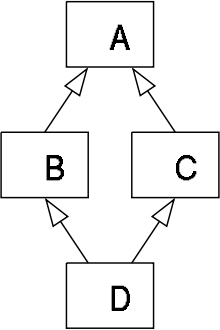
In the above example we use multiple inheritances and it is also called Diamond inheritance or Deadly Diamond of Death and it looks as follows:

Python follows a depth-first lookup order and hence ends up calling the method from class A. By following the method resolution order, the lookup order as follows.
Class D -> Class B -> Class C -> Class A
Python follows depth-first order to resolve the methods and attributes. So in the above example, it executes the method in class B.

Old and New Style Order :
In the older version of Python(2.1) we are bound to use old-style classes but in Python(3.x & 2.2) we are bound to use only new classes. New style classes are the ones whose first parent inherits from Python root ‘object’ class.


class OldStyleClass:

pass

class NewStyleClass(object):

pass

Method resolution order(MRO) in both the declaration style is different. Old style classes use DLR or depth-first left to right algorithm whereas new style classes use C3 Linearization algorithm for method resolution while doing multiple inheritances.

DLR Algorithm
During implementing multiple inheritances, Python builds a list of classes to search as it needs to resolve which method has to be called when one is invoked by an instance. As the name suggests, the method resolution order will search the depth-first, then go left to right. For Example

class A:

pass

class B:

pass

class C(A, B):

pass

class D(B, A):

pass

class E(C,D):

pass

In the above Example algorithm first looks into the instance class for the invoked method. If not present, then it looks into the first parent, if that too is not present then-parent of the parent is looked into. This continues till the end of the depth of class and finally, till the end of inherited classes. So, the resolution order in our last example will be D, B, A, C, A. But, A cannot be twice present thus, the order will be D, B, A, C. But this algorithm varying in different ways and showing different behaviours at different times .So Samuele Pedroni first discovered an inconsistency and introduce C3 Linearization algorithm.

C3 Linearization Algorithm :
C3 Linearization algorithm is an algorithm that uses new-style classes. It is used to remove an inconsistency created by DLR Algorithm. It has certain limitation they are:

  • Children precede their parents
  • If a class inherits from multiple classes, they are kept in the order specified in the tuple of the base class.

C3 Linearization Algorithm works on three rules:

  • Inheritance graph determines the structure of method resolution order.
  • User have to visit the super class only after the method of the local classes are visited.
  • Monotonicity


Methods for Method Resolution Order(MRO) of a class:
To get the method resolution order of a class we can use either __mro__ attribute or mro() method. By using these methods we can display the order in which methods are resolved. For Example

class A:

def rk(self):

print(" In class A")

class B:

def rk(self):

print(" In class B")

class C(A, B):

def __init__(self):

print("Constructor C")

r = C()

print(C.__mro__)

print(C.mro())

Output:


Constructor C
(<class '__main__.C'>, <class '__main__.A'>, <class '__main__.B'>, <class 'object'>)
[<class '__main__.C'>, <class '__main__.A'>, <class '__main__.B'>, <class 'object'>]


If you like GeeksforGeeks and would like to contribute, you can also write an article using contribute.geeksforgeeks.org or mail your article to [email protected] See your article appearing on the GeeksforGeeks main page and help other Geeks.

Please Improve this article if you find anything incorrect by clicking on the “Improve Article” button below.

Article Tags :


thumb_up
Be the First to upvote.

Please write to us at [email protected] to report any issue with the above content.


Post navigation


Previous

first_page Print first n distinct permutations of string using itertools in Python


Source link

Filed Under: c programming Tagged With: •   Dynamic Programming, 10 Interesting Python Cool Tricks, About Us, Advanced Data Structure, Advanced Topics, Algo ▼, Algorithm Paradigms ►, Algorithms, All Algorithms, All Data Structures, Analysis of Algorithms, Analyzing Mobile Data Speeds from TRAI with Pandas, Aptitude, Array, Backtracking, Binary Search Tree, Binary Tree, Bit Algorithms, Branch & Bound, C, Campus Ambassador Program, Careers, class method vs static method in Python, Company Prep, Company-wise, Competitive Programming, Compiler Design, Computer Graphics, Computer Network | Address Resolution in DNS, Computer Networks, Computer Organization, Computer Organization & Architecture, Contact Us, Contests, contribute.geeksforgeeks.org, contributed articles, Conversion Functions in Pandas DataFrame, Core Subjects ►, Counting the frequencies in a list using dictionary in Python, Courses, Creating a dataframe using Excel files, Cristian's Algorithm, CS Subjects, CS Subjects ▼, CS Subjectwise ►, CSS, Data Structures, DBMS, Dealing with Rows and Columns in Pandas DataFrame, Decorators in Python, Design Patterns, Destructors in Python, Different ways to iterate over rows in Pandas Dataframe, Digital Electronics, Divide and Conquer, DS ▼, Engg. Mathematics, examples of object, Experienced Interviews, Face Detection using Python and OpenCV with webcam, Game Theory, GATE ▼, GATE 2019, GATE CS Corner, GATE Notes, GATE Official Papers, GBlog, Geek of the Month, Geek on the Top, Generating random number list in Python, Generating subarrays using recursion, Geometric Algorithms, Graph, Graph Algorithms, Greedy Algorithms, Hashing, Heap, heapq in Python to print all elements in sorted order from row and column wise sorted matrix, How to assign values to variables in Python and other languages, HTML, HTML & XML, ide.geeksforgeeks.org, Indentation and Comment in Python, Inheritance in Python, Inheritance in Python | Set 2, Internship, Internship Interviews, Internships, Interview ▼, Interview Experiences, ISRO CS Exam, issubclass and super), Java, JavaScript, Languages, Languages ►, Languages ▼, Last Minute Notes, Linear Regression Using Tensorflow, LinkedList, Logic Gates in Python, Machine Learning, Mathematical Algorithms, Matrix, Microprocessor, ML | Cancer cell classification using Scikit-learn, Multiple Choice Quizzes, Namespaces and Scope in Python, OOP in Python | Set 3 (Inheritance, Operating Systems, Operator Overloading in Python, Output of Python Programs | (Dictionary), Overuse of lambda expressions in Python, Pattern Searching, PHP, Placement Course, Polymorphism in Python, Practice, Practice Company Questions, Print first n distinct permutations of string using itertools in Python, Priority Queue in Python, Privacy Policy, Program Output, Project, Puzzles, Python, Python | Automating Happy Birthday post on Facebook using Selenium, Python | Catching the ball game, Python | Check order of character in string using OrderedDict( ), Python | Count occurrences of a character in string, Python | Delete rows/columns from DataFrame using Pandas.drop(), Python | Get the real time currency exchange rate, Python | Implementation of Movie Recommender System, Python | Inserting item in sorted list maintaining order, Python | NLP analysis of Restaurant reviews, Python | Output Formatting, Python | Output using print() function, Python | Pandas TimedeltaIndex.resolution, Python | Plotting Doughnut charts in excel sheet using XlsxWriter module, Python | Program to generate one-time password (OTP), Python | range() method, Python | Real time currency convertor using Tkinter, Python | Real time weather detection using Tkinter, Python | Removing dictionary from list of dictionaries, Python | Simple FLAMES game using Tkinter, Python | Sort Python Dictionaries by Key or Value, Python | Sort Tuples in Increasing Order by any key, Python | Sort words of sentence in ascending order, Python | Tokenize text using TextBlob, Python code to print common characters of two Strings in alphabetical order, Python in Competitive Programming, Python List Comprehension | Sort even-placed elements in increasing and odd-placed in decreasing order, Python list sort(), Python program to add two numbers, Python program to check whether a number is Prime or not, Python program to count words in a sentence, Python-Functions, python-inheritance, Queue, Quizzes ▼, Randomized Algorithms, School Programming, Scope Resolution in Python | LEGB Rule, Searching Algorithms, Skip to content, Software Engineering, Some rights reserved, Sort the words in lexicographical order in Python, Sorting Algorithms, SQL, Stack, Statement, Strings, Structuring Python Programs, Students ▼, Subjective Questions, Taking input from console in Python, Taking input in Python, Taking multiple inputs from user in Python, Technical Scripter, Testimonials, Theory of Computation, Top Topics, Topic-wise, Topicwise ►, Tree based DS ►, UGC NET CS Paper II, UGC NET CS Paper III, UGC NET Papers, Video Tutorials, Videos, Web Technology, What is the Python Global Interpreter Lock (GIL), What’s Difference?, Working With JSON Data in Python, Working with Missing Data in Pandas, Write an Article, Write Interview Experience

Python | Convert a list of multiple integers into a single integer

Leave a Comment


Given a list of integers, write a Python program to convert the given list into a single integer.

Examples:


Input : [1, 2, 3]
Output : 123

Input : [55, 32, 890]
Output : 5532890

There are multiple approaches possible to convert the given list into a single integer. Let’s see each one by one.

Approach #1 : Naive Method
Simply iterate each element in the list and print them without space in between.

lst = [12, 15, 17]

for i in lst:

print(i, end="")

Output:

121517


Approach #2 : Using join()

Use the join() method of Python. First convert the list of integer into a list of strings( as join() works with strings only). Then, simply join them using join() method. It takes a time complexity of O(n).

def convert(list):

s = [str(i) for i in list]

res = int("".join(s))

return(res)

list = [1, 2, 3]

print(convert(list))

Output:

123


Approach #3 : Using map()

Another approach to convert a list of multiple integers into a single integer is to use map() function of Python with str function to convert the Integer list to string list. After this, join them on the empty string and then cast back to integer.

def convert(list):

res = int("".join(map(str, list)))

return res

list = [1, 2, 3]

print(convert(list))

Output:

123


Approach #4 : Multiplying by corresponding power of 10

A more mathematical way, which does not require to convert the integer list to string list is, to multiply each integer element with its corresponding power of 10, and then summing it up. It takes a time complexity of O(n).

def convert(list):

res = sum(d * 10**i for i, d in enumerate(list[::-1]))

return(res)

list = [1, 2, 3]

print(convert(list))

Output:

123

A small variation to this program leads to less computation in calculation of sum, i.e. using reduce(). This makes use of Horner’s rule, which factors the polynomial representing the number to reduce the number of multiplications.

res = functools.reduce(lambda total, d: 10 * total + d, list, 0)


If you like GeeksforGeeks and would like to contribute, you can also write an article using contribute.geeksforgeeks.org or mail your article to [email protected] See your article appearing on the GeeksforGeeks main page and help other Geeks.

Please Improve this article if you find anything incorrect by clicking on the “Improve Article” button below.

Article Tags :


thumb_up
Be the First to upvote.

Please write to us at [email protected] to report any issue with the above content.


Post navigation


Previous

first_page Python | Add new keys to a dictionary


Source link

Filed Under: c programming Tagged With: •   Dynamic Programming, A single neuron neural network in Python, About Us, Advanced Data Structure, Advanced Topics, Algo ▼, Algorithm Paradigms ►, Algorithms, All Algorithms, All Data Structures, Analysis of Algorithms, Aptitude, Array, Array in Python | Set 1 (Introduction and Functions), Backtracking, Basic calculator program using Python, Binary Search Tree, Binary Tree, Bit Algorithms, Branch & Bound, C, Campus Ambassador Program, Careers, class method vs static method in Python, Class or Static Variables in Python, Company Prep, Company-wise, Competitive Programming, Compiler Design, Computer Graphics, Computer Networks, Computer Organization, Computer Organization & Architecture, Conditions and Functions), Contact Us, Contests, contribute.geeksforgeeks.org, contributed articles, Core Subjects ►, Count words in a given string, Courses, CS Subjects, CS Subjects ▼, CS Subjectwise ►, Data Structures, DBMS, Design Patterns, Digital Electronics, Divide and Conquer, DS ▼, Engg. Mathematics, Enumerate() in Python, Experienced Interviews, Expressions, extend()...), Find the first non-repeating character from a stream of characters, Function Decorators in Python | Set 1 (Introduction), Game Theory, GATE ▼, GATE 2019, GATE CS Corner, GATE Notes, GATE Official Papers, GBlog, Geek of the Month, Geek on the Top, Geometric Algorithms, Global and Local Variables in Python, Graph, Graph Algorithms, Greedy Algorithms, Hashing, Heap, Heap queue (or heapq) in Python, How to check if a string is a valid keyword in Python?, How to input multiple values from user in one line in Python?, How to print without newline in Python?, How to split a string in C/C++, HTML & XML, ide.geeksforgeeks.org, Important differences between Python 2.x and Python 3.x with examples, insert(), Internship, Internship Interviews, Internships, Interview ▼, Interview Experiences, ISRO CS Exam, Iterations), Java, JavaScript, join() function in Python, Keywords in Python | Set 1, Keywords in Python | Set 2, Languages, Languages ►, Languages ▼, Last Minute Notes, len(), Linear Regression (Python Implementation), LinkedList, List Methods in Python | Set 1 (in, List Methods in Python | Set 2 (del, Lists, Machine Learning, map, Mathematical Algorithms, Matrix, max()...), Microprocessor, min(), Multiple Choice Quizzes, Multiplication of two Matrices in Single line using Numpy in Python, not in, NumPy in Python | Set 1 (Introduction), Object and Members, Object Oriented Programming in Python | Set 1 (Class, Operating Systems, Pattern Searching, Permutation and Combination in Python, PHP, Placement Course, pop(), Practice Company Questions, Print lists in Python (4 Different Ways), Print Single and Multiple variable in Python, Privacy Policy, Program Output, Program to print N minimum elements from list of integers, Project, Puzzles, Python, Python | Add new keys to a dictionary, Python | Check whether a list is empty or not, Python | Convert a list of characters into a string, Python | Convert a list of Tuples into Dictionary, Python | Convert a nested list into a flat list, Python | Convert an array to an ordinary list with the same items, Python | Program to convert String to a List, Python | Program to print duplicates from a list of integers, Python | Set 2 (Variables, Python | Set 3 (Strings, Python 3 basics, Python and Java?, Python code to move spaces to front of string in single traversal, Python Dictionary, Python GUI - tkinter, Python Input Methods for Competitive Programming, Python lambda (Anonymous Functions) | filter, Python Language Introduction, Python List, Python list | index(), Python list sort(), Python list-programs, Python map() function, Python program to find largest number in a list, Python program to find N largest elements from a list, Python program to print all negative numbers in a range, Python program to print all odd numbers in a range, Python program to right rotate a list by n, Python Slicing | Reverse an array in groups of given size, Python String, Python String | split(), Python Tuples, Queue, Quizzes ▼, Randomized Algorithms, range() vs xrange() in Python, reduce, Remove multiple elements from a list in Python, remove(), Rename multiple files using Python, Returning Multiple Values in Python, Reverse string in Python (5 different ways), School Programming, Searching Algorithms, Sets in Python, Skip to content, Software Engineering, Some rights reserved, sort(), Sorting Algorithms, SQL, Stack, Strings, Students ▼, Subjective Questions, Suggest a Topic, Testimonials, Theory of Computation, Top Topics, Topic-wise, Topicwise ►, Transpose a matrix in Single line in Python, Tree based DS ►, Tuples, Twitter Sentiment Analysis using Python, Type Conversion in Python, UGC NET CS Paper II, UGC NET CS Paper III, UGC NET Papers, Video Tutorials, Videos, Web Technology, What’s Difference?, When to use yield instead of return in Python?, Write an Article, Write Interview Experience

Primary Sidebar

Recent Posts

  • Total Quality Management Questions and Answers – Agile Manufacturing
  • How to Become a Cyber Security Engineer?
  • How to Become a Software Architect?
  • 7 Best Languages to Learn IoT Development in 2020
  • REDIS Tutorial: Beginners
  • Privacy Policy
  • About
  • Contact US

© 2020 ProProgramming Privacy Policy About Contact Us