Today we are going to write a program to find the inverse of matrix C++, so let’s start with the what is the inverse of a matrix.
Inverse of Matrix:
For a square matrix A, the inverse is written A-1. When A is multiplied by A-1 the result is the identity matrix I. Non-square matrices do not have inverses.
Note: Not all square matrices have inverses. A square matrix which has an inverse is called invertible or nonsingular, and a square matrix without an inverse is called non-invertible or singular.
AA-1 = A-1A = I
| Example: | For matrix 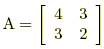 , its inverse is , its inverse is 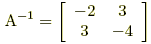 since since |
AA-1 =  and A-1A = and A-1A =  . . |
Program to find Inverse of a Matrix C++:
#include<iostream>
using namespace std;
int main(){
    int mat[3][3], i, j;
    float determinant = 0;
    cout<<"Enter elements of matrix row wise:\n";
    for(i = 0; i < 3; i++)
        for(j = 0; j < 3; j++)
           cin>>mat[i][j];
    printf("\nGiven matrix is:");
    for(i = 0; i < 3; i++){
        cout<<"\n";
        for(j = 0; j < 3; j++)
            cout<<mat[i][j]<<"\t";
    }
    //finding determinant
    for(i = 0; i < 3; i++)
        determinant = determinant + (mat[0][i] * (mat[1][(i+1)%3] * mat[2][(i+2)%3] - mat[1][(i+2)%3] * mat[2][(i+1)%3]));
    cout<<"\n\ndeterminant: "<<determinant;
    cout<<"\n\nInverse of matrix is: \n";
    for(i = 0; i < 3; i++){
        for(j = 0; j < 3; j++)
            cout<<((mat[(j+1)%3][(i+1)%3] * mat[(j+2)%3][(i+2)%3]) - (mat[(j+1)%3][(i+2)%3] * mat[(j+2)%3][(i+1)%3]))/ determinant<<"\t";
        cout<<"\n";
    }
   return 0;
}
OUTPUT:
$g++ -o main *.cpp
$main
Enter elements of matrix row wise:
Given matrix is:
4545	1184	0
0	4197472	0
4196160	0	1289235200
determinant: 1.48138e+09
Inverse of matrix is:
-0.871163	-1.17531	0
0	0.836105	0
0.26784	0.454498	1.28099